

I recently had the opportunity to present at the Eastern Evaluation Research Society’s annual conference, which took place from May 1, 2016 to May 3, 2016 this year.

At the conference, I presented on two main topics:
1.The Importance of Implementing Data and Accountability Feedback Loops in Mission Driven Organizations.

This presentation highlighted DCPNI’s Data and Accountability Feedback Loop to ensure program staff and external partners have the capacity to provide evidence-based, high-quality programming.
Whether you are a funder or leading data activities for your organization, receiving or providing performance feedback is not always easy. However, the information you receive can be essential to ensuring efforts are on track to meet organizational outcomes and priorities.
As a direct service provider and a grant-making organization, the mission of DC Promise Neighborhood Initiative is to end intergenerational poverty in Washington DC’s Kenilworth-Parkside community. To do this work, DCPNI funds local organizations to provide a range of services to residents with-in its geographic footprint.
Our use of a multi-faceted system for giving and receiving feedback helps position DCPNI and its partners to achieve results.
For the presentation, we explored the following topics: the use of on-going capacity assessment with staff and external partners; developing, implementing, and assessing a detailed strategic plan; monitoring performance; celebrating successes; taking corrective action; and using formative data strategies to identify results.
The presentation also highlighted how the funder-client feedback loop differs from the service-delivery feedback loop as it relates to reporting, performance monitoring, evaluation and compliance.
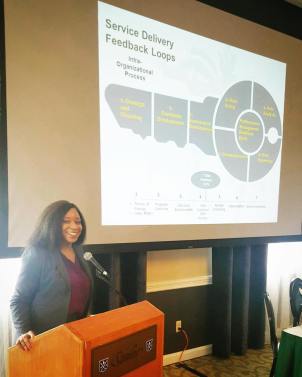
Giving my first presentation at the EERS conference
2. Engaging and Equipping Community Residents for Action through Evaluation.
For this panel, we described the process of equipping residents with information to advocate for themselves. The goal of this project was related to that of the first presentation in that it involved the thoughtful engagement of community residents around key data points; however, it differed in its intention. Rather than using community interpretations to inform DCPNI’s strategic decisions (e.g., recruitment of providers, expansion/reduction of services), this approach empowered the community to act directly by using data generated by the community. The presentation related to the conference theme of “building knowledge,” as it explores DCPNI’s approach to sharing relevant information with residents and fostering community-driven change.
At the conference, my colleagues and I highlighted DCPNI’s approach to providing Community Action Teams with actionable data points and other sources of information to catalyze collective advocacy. The presentation will highlight the importance of identifying community champions; communicating findings in understandable ways; bridging barriers between residents and institutions; and maintaining momentum. It also tied in themes from the first presentation (e.g., balancing assets with deficits, respecting unique cultural perspectives/approaches).
Finally, we shared findings from multiple Community Action Team efforts, including a successful petition to the transportation authority to maintain an essential community bus route that had been slated for discontinuation. The audience participated by sharing their experiences and considering implications for place-based mission sustainability through community empowerment.
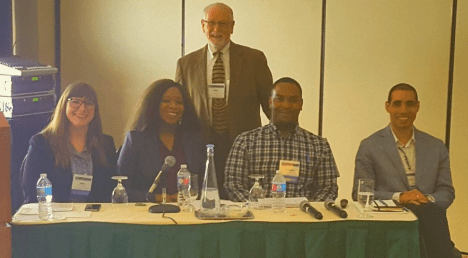
DCPNI Data and Evaluation Team with panel moderator – Villanova Professor John Kelley
 Ijeoma Anyanwu